Twelve Seconds That Started Aviation
The first powered flight in history covered less ground than the wingspan of a modern jumbo jet.
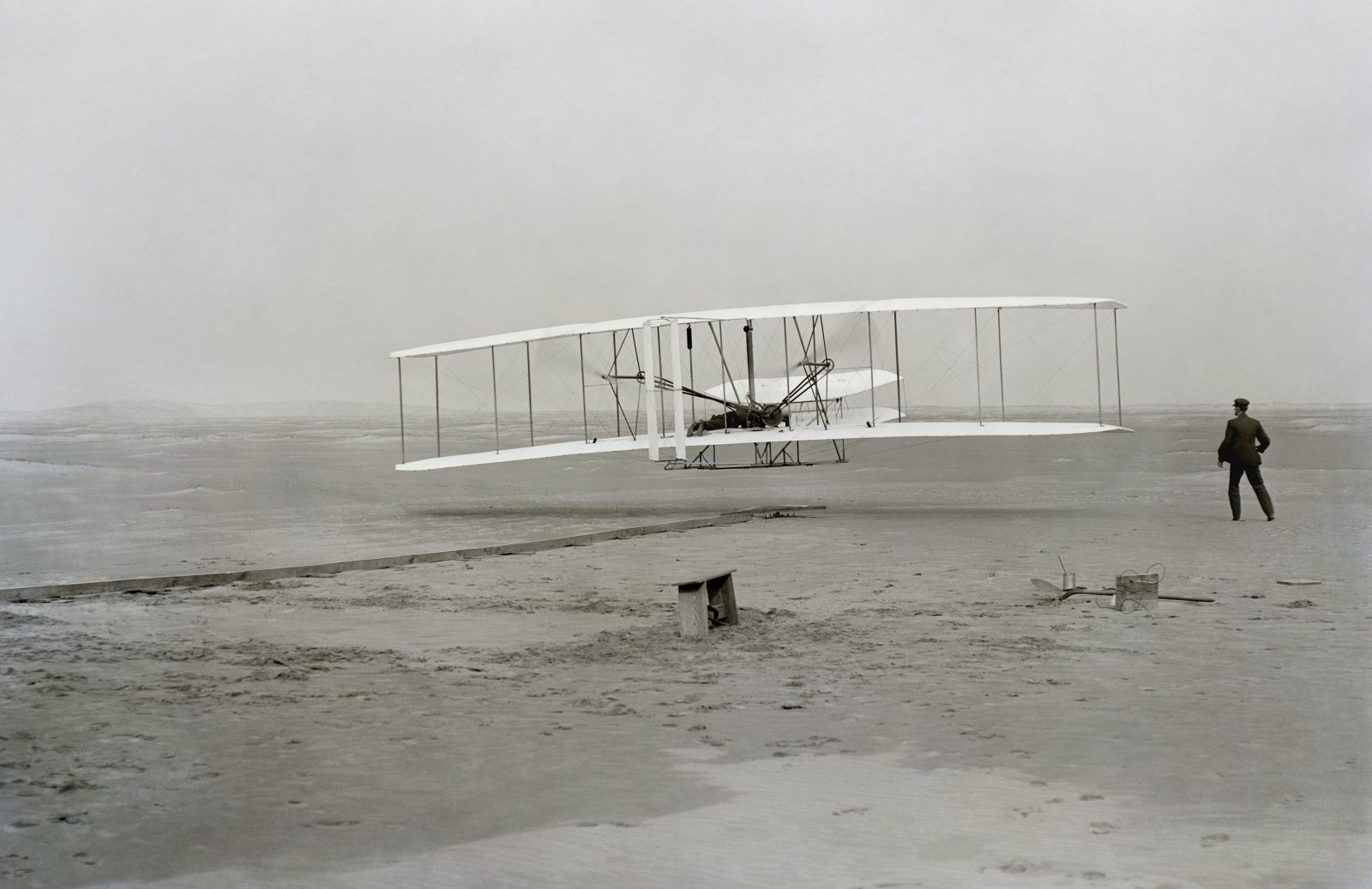
Photo: John T. Daniels / Library of Congress, 1903 — public domain
On the morning of December 17, 1903, on a windswept beach at Kitty Hawk, North Carolina, Orville Wright lay flat on the lower wing of a fragile wood-and-fabric aircraft and pushed a lever. The Wright Flyer lifted off the ground, flew for 12 seconds, and covered 120 feet — a distance shorter than the wingspan of a Boeing 747.
Five people watched. There was no fanfare; the local newspaper ran its own account the next morning, and got most of the details wrong.
What made it historic wasn't distance — it was control. Balloons and gliders had left the ground before. The Wrights' real breakthrough was "wing warping," a system of cables that let the pilot twist the wingtips to bank and steer, solving the control problem that had defeated earlier attempts. They'd worked it out first with kites, then a wind tunnel they built themselves in their bicycle shop in Dayton, Ohio, testing about 200 wing shapes by hand.
They built almost everything themselves, including the engine. Their mechanic, Charlie Taylor, made a four-cylinder, water-cooled gasoline engine that produced about 12 horsepower and weighed 180 pounds. The whole Flyer had a wingspan of just over 40 feet and weighed 605 pounds empty. It needed help from the weather, too: the wind that day was over 20 miles an hour, enough to get it off level ground.
They flew three more times that day. Wilbur's first flight went 175 feet in 12 seconds, and Orville's second covered 200 feet in 15. The last flight, piloted by Wilbur, covered 852 feet and stayed up for 59 seconds — genuinely sustained, controlled flight. One of the five onlookers, John T. Daniels, took the famous photograph of the first lift-off. A gust of wind tumbled the Flyer shortly after landing and it never flew again, but by then it didn't need to.
Sources
- Wright Flyer — Wikipedia