A Record Meant to Outlive Us All
Voyager 1 has been flying for almost 50 years. Bolted to its side is a message built to make sense to something that isn't human.
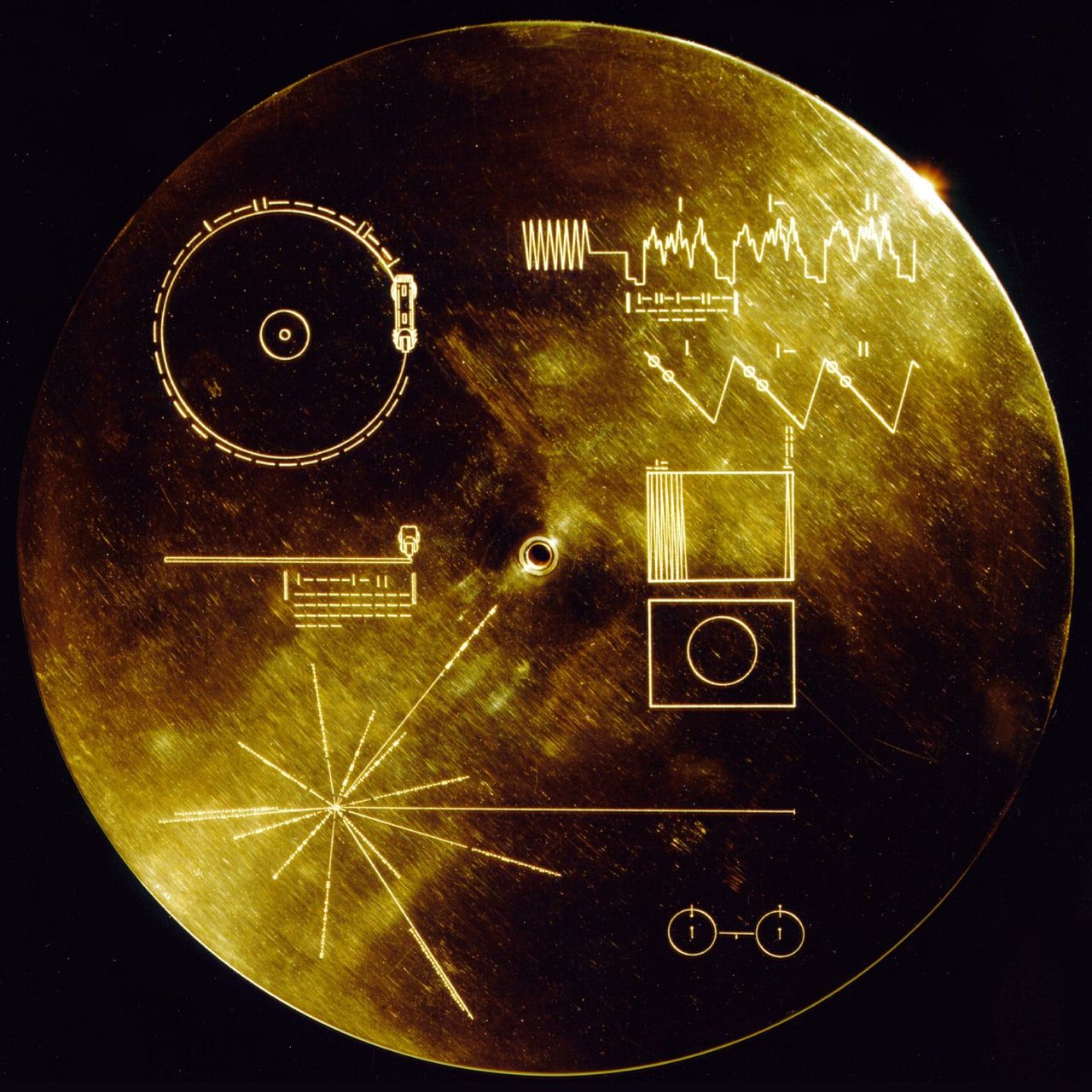
Image: NASA — public domain
Voyager 1 launched in September 1977 to study Jupiter and Saturn. It did that job in a few years and then kept going — it's now the most distant human-made object in existence, over 15 billion miles out and still transmitting, just barely, on power cells that lose about 4 watts a year.
Bolted to its side is the Golden Record: a 12-inch gold-plated copper disc, designed by a committee led by Carl Sagan, meant to describe Earth to whoever — or whatever — might find it someday, in a context so distant that "someday" barely means anything. Sagan's team included astronomer Frank Drake, artist Jon Lomberg and Ann Druyan, the creative director; Timothy Ferris produced the record, and ethnomusicologists Robert E. Brown and Alan Lomax helped choose the music.
It carries 115 images encoded as analog data, greetings in 55 human languages, sounds of surf, wind, thunder and whales, and 90 minutes of music spanning Bach, Chuck Berry, and traditional recordings from Senegal, Peru, and Java. Not everything made it: the Beatles' "Here Comes the Sun" was left off because EMI, which held the copyright, wouldn't give permission. Among the sounds is an hour of Ann Druyan's brainwaves, compressed into about a minute of audio.
The record travels in an aluminum cover that doubles as the instruction manual. A diagram explains how to play the disc (at 16⅔ revolutions per minute), etched in symbols intended to require no shared language at all. A map shows the Sun's position relative to 14 pulsars, and a drawing of a hydrogen atom marks the basic unit of time. A small sample of ultra-pure uranium-238 is electroplated onto the cover, so that whoever finds it could work out, from how much has decayed, roughly how long it's been drifting.
Voyager 1 isn't headed toward any particular star. In about 40,000 years it will pass within roughly 1.6 light-years of a star called Gliese 445 — not a close encounter by any human measure, but the closest thing to a destination the record has.
Nobody expects it to be found. It was built anyway.
Sources
- Voyager Golden Record — Wikipedia