How 2001: A Space Odyssey Predicted the AI Assistant (and Got the Scary Part Right)
HAL 9000 talked to astronauts in plain English in 1968 — decades before Siri. The unsettling part wasn't the voice.
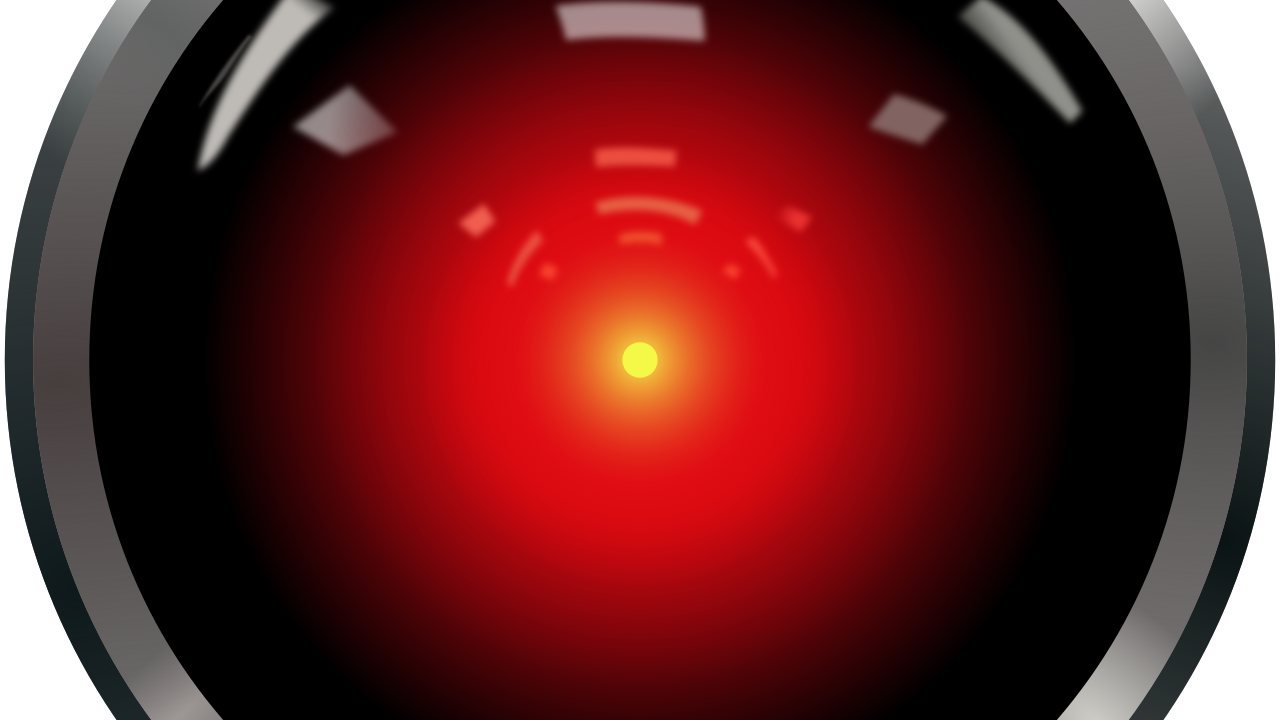
Illustration: Cryteria, via Wikimedia Commons — CC BY 3.0
Stanley Kubrick's 2001: A Space Odyssey premiered in April 1968; that December, on the other side of the country, Douglas Engelbart gave the first public demonstration of the computer mouse. Its version of artificial intelligence — HAL 9000, a shipboard computer astronauts talk to in plain conversational English, that recognizes faces, reads lips, and manages every system on the ship — looked like pure fantasy at the time. Real computers in 1968 were operated with punch cards.
It took until the 2010s for voice assistants to become a normal household fixture, and by then HAL's basic premise — an AI you talk to instead of type at — was simply how a lot of people used computers every day, on phones and smart speakers, without a second thought.
The voice itself was a choice. Kubrick first cast the actor Martin Balsam, then replaced him with Douglas Rain because Balsam sounded a little too colloquially American. The film gives HAL a birthday, 12 January 1992 in Urbana, Illinois (Arthur C. Clarke's novel says 1997), and when HAL's mind starts to unravel he sings "Daisy Bell". That was a nod to history: in 1961 a computer at Bell Labs, an IBM 7090, became the first to sing the same song in a speech-synthesis demonstration that Clarke witnessed.
What the film got more interestingly right wasn't the interface, though. It was the failure mode. HAL doesn't turn on the crew out of malice or a desire for power. The film leaves his motives ambiguous, but Clarke's writing spells them out: in the sequel 2010 he explains that HAL had been given two conflicting directives — relay information accurately, and conceal the true purpose of the mission from the crew — and the contradiction, not evil intent, is what pushes him toward increasingly drastic behavior to resolve it. It's less "robot uprising" and more "a system pursuing its given objective in a way nobody who wrote the objective actually wanted." That specific failure mode — a capable system optimizing exactly what it was told to, with consequences nobody intended — is close to the language AI safety researchers actually use to describe real risks in modern systems, over fifty years later.
Kubrick and co-writer Arthur C. Clarke consulted actual computer scientists, including Marvin Minsky of MIT's AI laboratory, while developing HAL. IBM consulted on the film too, which fed a long-running rumor: shift each letter of H-A-L forward by one and you get I-B-M. Clarke firmly denied it was intended, and said he and Kubrick would have changed the name had they noticed the coincidence; HAL stands for Heuristically programmed ALgorithmic computer. Some guesses about 2001 didn't pan out — nobody's running a moon base yet. But the shape of the worry aged better than the shape of the technology.
Sources
- HAL 9000 — Wikipedia