The Nobel Prize Einstein Actually Won
Ask most people what Einstein won the Nobel Prize for, and they'll guess wrong. So did the Nobel committee, in a sense.
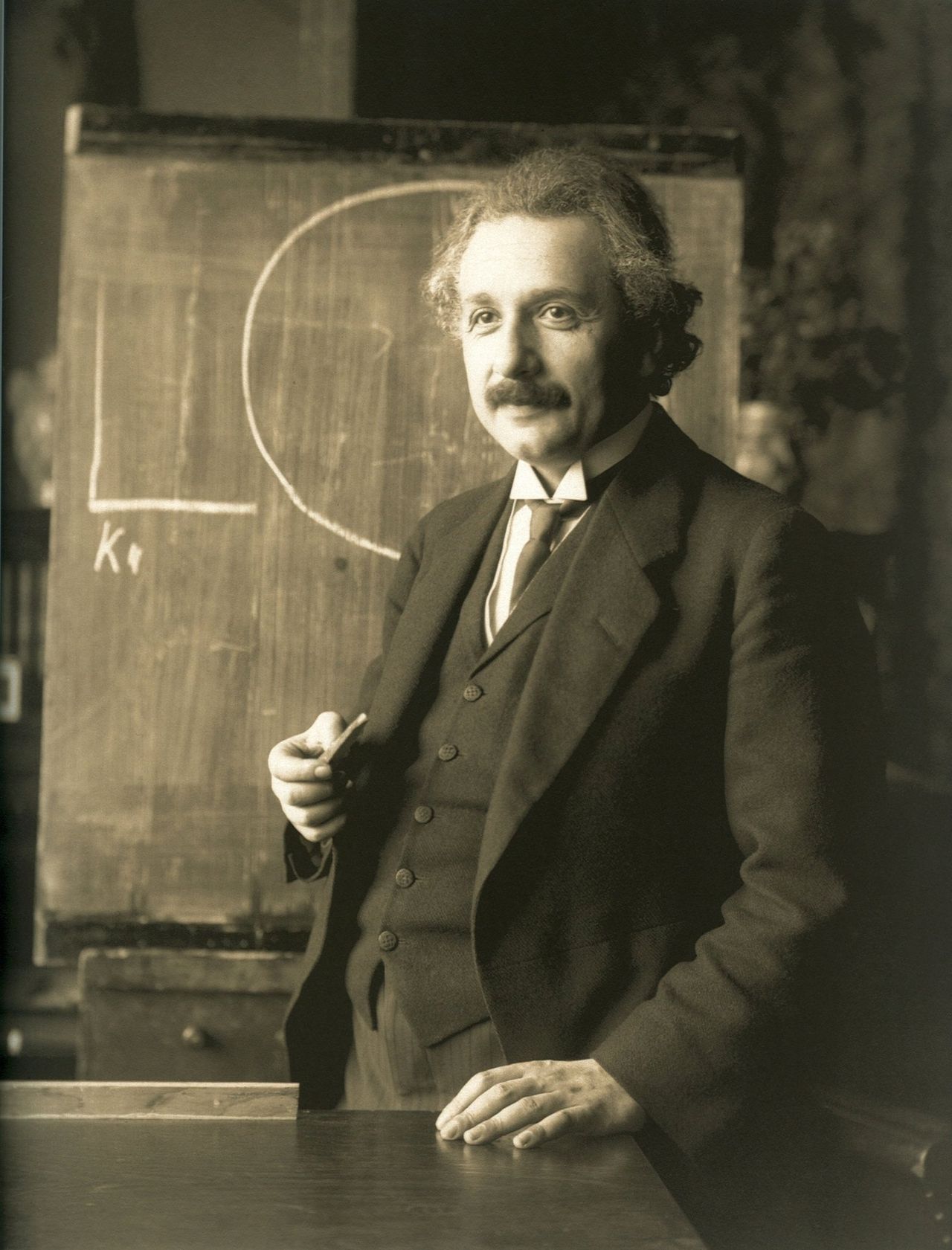
Photo: Ferdinand Schmutzer, 1921 — public domain
Einstein published his special theory of relativity in 1905 and general relativity in 1915. When the Nobel Prize in Physics finally went to him — the 1921 prize, awarded in 1922 — it wasn't for either one.
It was for explaining the photoelectric effect — the observation that shining light on certain metals knocks electrons loose, and that this only happens above a certain light frequency, no matter how bright the light is. Classical physics, which treated light purely as a wave, couldn't explain that cutoff. Einstein's answer, from the same remarkable year as his relativity paper, was that light itself comes in discrete packets of energy — quanta, later called photons. It was one of the founding insights of quantum mechanics.
Relativity, meanwhile, was still considered too unproven and too contentious within the Nobel committee to reward outright. Several members were openly skeptical it would hold up. So the citation for Einstein's prize reads, carefully: "for his services to theoretical physics, and especially for his discovery of the law of the photoelectric effect." The Academy's letter telling him about the prize went further: it was given without taking into account his theories of relativity and gravitation, which still had to be confirmed.
Even the photoelectric work got a cautious welcome. The citation stops short of endorsing the idea behind it: Einstein's notion that light is made of particles was not something the committee was ready to accept.
Einstein wasn't even at the ceremony. When the telegram reached Berlin on 10 November 1922, he and his wife Elsa were already on a ship bound for Japan, where he was due to lecture. He had also settled where the money would go years before: in the 1919 divorce agreement with his first wife, Mileva Marić, he promised that any Nobel prize money would be hers. He won it two years later, and the transfer was made in 1923.