5 World-Changing Discoveries That Happened by Total Accident
Some of history's biggest breakthroughs came from a dirty petri dish, a glowing screen, or a scientist who forgot to wash his hands.
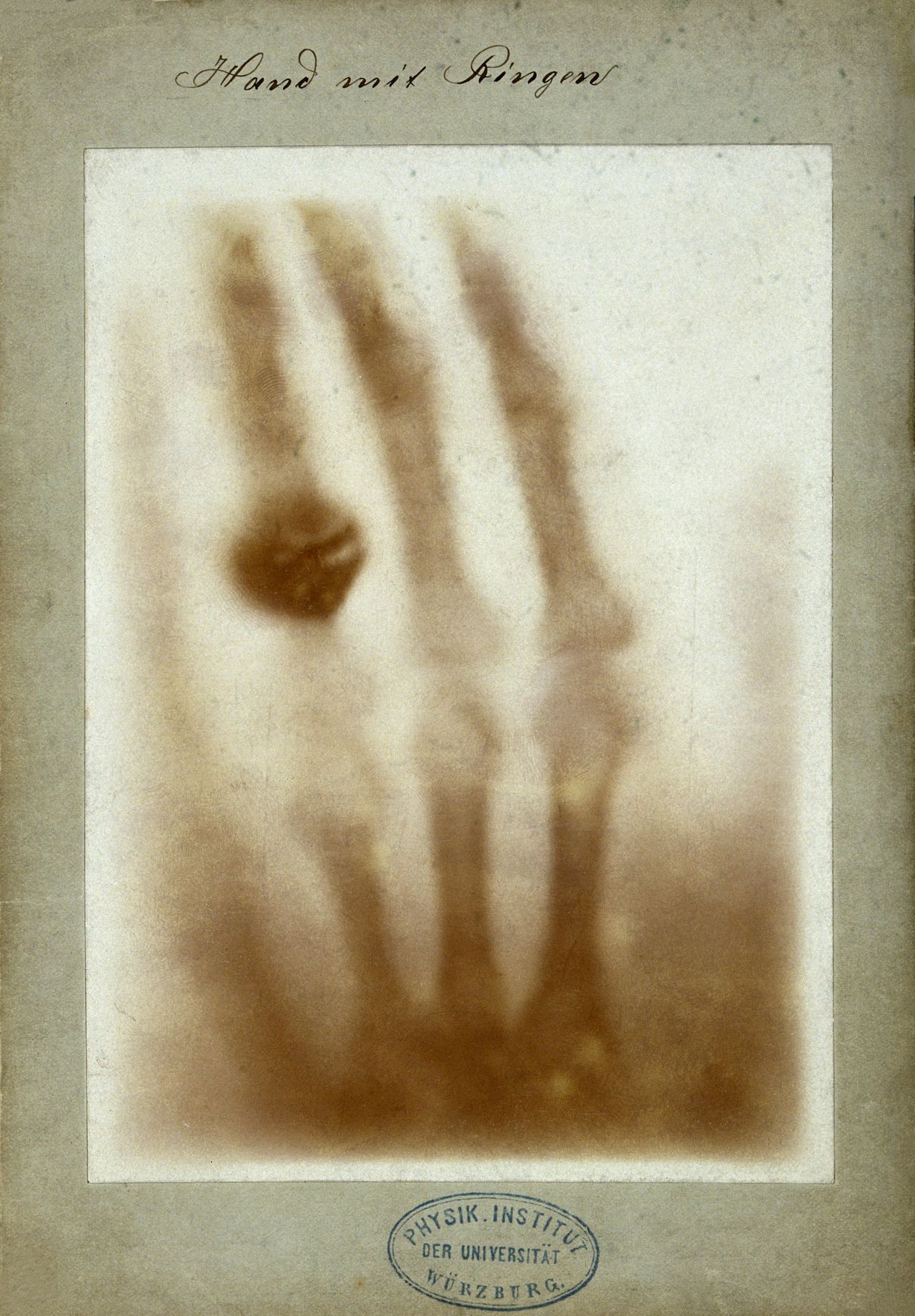
Photo: Wilhelm Röntgen, 1895 — public domain
Science doesn't always advance by careful hypothesis and controlled experiment. Sometimes it advances because someone noticed something weird happening right in front of them and asked why — even when they weren't looking for it at all.
-
Penicillin (1928) — Alexander Fleming came back from vacation to find mold growing in a petri dish he'd forgotten to clean, and noticed the mold was killing the bacteria around it. We covered the full story here.
-
The microwave oven (1945) — The popular story goes that Raytheon engineer Percy Spencer was standing near an active radar magnetron when a chocolate bar in his pocket melted, and that he went on to test popcorn and then an egg, which exploded. There's no credible primary source for the chocolate bar, so treat that part as legend. What is documented is the result: Spencer, a self-taught engineer who had been orphaned young and left school early, had helped lift Raytheon's magnetron output during World War II from 100 to 2,600 a day, and on October 8, 1945 the company filed a patent application for a microwave cooking oven. The first commercial model, in 1947, stood about six feet tall, weighed around 750 pounds and cost roughly $5,000.
-
Vulcanized rubber (1839) — Charles Goodyear had spent years failing to make rubber durable enough to survive heat and cold, sinking deep into debt in the process. Then, according to his biographers, he accidentally dropped a rubber-and-sulfur mixture onto a hot stove at the Eagle India Rubber Company in Woburn, Massachusetts — and instead of melting, it hardened into a tough, weatherproof material. He called the process vulcanization, after the heat involved, and received US patent 3633 in 1844. It didn't make him rich: a British rubber pioneer, Thomas Hancock, won a rival patent, and Goodyear died in 1860 with his estate almost $200,000 in debt.
-
Saccharin (1879) — Chemist Constantin Fahlberg was working in Ira Remsen's laboratory at Johns Hopkins, studying coal-tar derivatives, when he noticed a sweet taste on his hand that evening and connected it to the compound he'd been making that day — the world's first artificial sweetener, hundreds of times sweeter than sugar. Credit later turned bitter: Fahlberg patented his production method in 1884 and built a factory near Magdeburg, and Remsen was blunt about it, calling Fahlberg a scoundrel. Saccharin stayed fairly obscure until sugar shortages in World War I.
-
X-rays (1895) — Physicist Wilhelm Röntgen was experimenting with cathode ray tubes in a darkened lab at Würzburg on November 8 when he noticed a nearby screen, painted with a fluorescent barium compound, glowing even though it wasn't anywhere near the tube's direct path. He'd discovered a new form of radiation that could pass through solid objects, and he labelled it "X" for unknown. On December 22 he made the first X-ray photograph of his wife Bertha's hand. He refused to patent the discovery, wanting everyone to benefit, and in 1901 won the first Nobel Prize in Physics.
None of these people set out to invent what they're remembered for. They just paid attention when something didn't behave the way it was supposed to.
Sources
- Charles Goodyear — Wikipedia
- Saccharin — Wikipedia