5 Practical Movie Effects Tricks That Still Hold Up
Long before CGI, filmmakers solved impossible shots with forced perspective, models, and one very uncooperative mechanical shark.
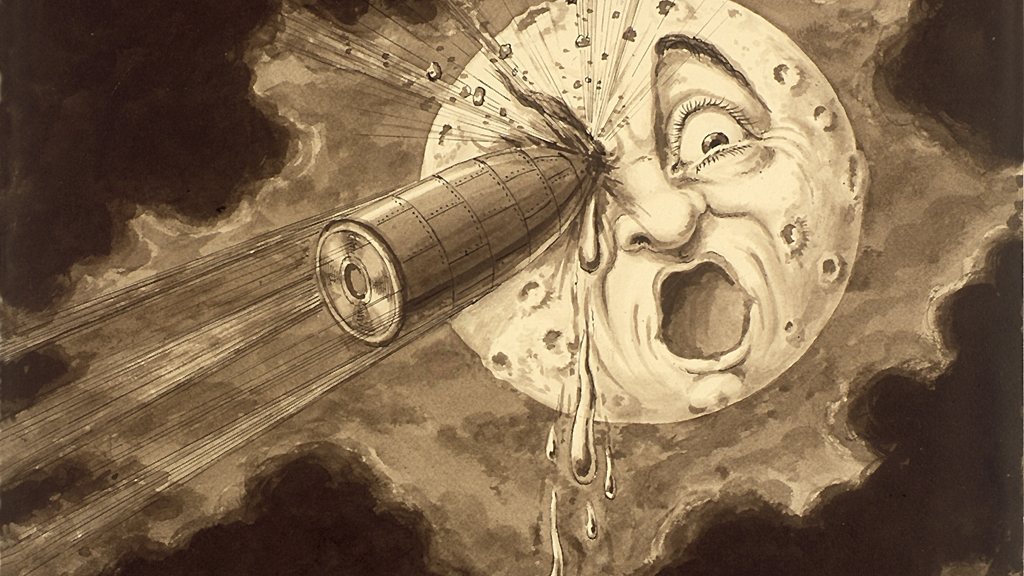
Drawing: Georges Méliès, 1902 — public domain
Modern blockbusters lean hard on computer-generated effects, but some of cinema's most convincing illusions were built entirely with cameras, sets, and clever geometry.
-
Forced perspective — The Lord of the Rings trilogy (2001–2003) made hobbits look genuinely small by building sets with two matching versions at different scales, then lining up the camera so a normal-sized actor standing farther back appeared shrunk down next to one standing closer. Parts of the sets were even mounted on moving platforms that shifted precisely with the camera, so the illusion held for the whole shot. In the real world the gap between Elijah Wood (Frodo) and Ian McKellen (Gandalf) is only about five inches. Where it worked, it needed no compositing at all, though the production mixed it with scale doubles, bluescreen and digital doubles, shot by shot. The trick isn't new: forced perspective was a feature of German silent films, and Citizen Kane revived it.
-
Miniatures — The original Star Wars (1977) filled space with detailed physical model spaceships, shot using a computer-controlled camera rig that could repeat the exact same movement across multiple passes. George Lucas set up Industrial Light & Magic in 1975 to do the work, in a warehouse in Van Nuys, California. Three years later, in The Empire Strikes Back (1980), the Hoth walkers were stop-motion miniatures set against matte paintings.
-
Rear projection — Classic Hollywood used it to put actors against moving backgrounds: the actors stand in front of a screen while a projector behind it plays pre-filmed footage. Fox put it to work in 1930 on Liliom and Just Imagine, and by the late studio era no car chase, train journey or taxi ride was safe from it. Alfred Hitchcock leaned on it constantly — James Stewart drives through rear-projected San Francisco in Vertigo (1958), and Cary Grant's Riviera roads in To Catch a Thief (1955) were screened in behind him. The audience mostly accepted it, but the projected image was always a little less crisp than the live action in front of it, and the technique faded as front projection and bluescreen proved sharper and cheaper. Stanley Kubrick was one of the killers: he chose front projection over rear projection for the Dawn of Man sequence in 2001: A Space Odyssey (1968) precisely because rear projection wasn't clean or big enough for what he wanted.
-
A mechanical shark that kept breaking — Jaws (1975) was supposed to show its shark constantly. Instead, the pneumatic shark — nicknamed "Bruce," after Spielberg's lawyer — malfunctioned so often that Steven Spielberg was forced to suggest its presence with a fin, a POV shot, or just John Williams' score. Salt water got into the air hoses and corroded the skin, and a shoot scheduled for 55 days took 159. Spielberg later called the shark's failure a godsend: it made him work more like Hitchcock than like Ray Harryhausen. The result was scarier than the full reveal would have been.
-
Bullet time — The Matrix (1999) popularized freezing a moment in time while the camera appears to swing around it, using a rig of around 120 still cameras fired in rapid sequence around the action. The underlying technique predates the film by years: Eadweard Muybridge used a line of cameras to photograph a running horse in 1878, and music videos and commercials were doing versions of it through the 1980s and '90s. What set The Matrix apart was the work of John Gaeta and Manex Visual Effects, who blended the camera array with interpolation, digital compositing and computer-generated scenery. It's why everyone remembers it.
Sometimes the most convincing illusion is the one built with the least technology available.
Sources
- Industrial Light & Magic — Wikipedia