Anatomy of a Nerd: Where the Classic Look Really Came From
Glasses, braces, a pocket protector and a calculator watch: the standard-issue movie nerd, taken apart piece by piece.
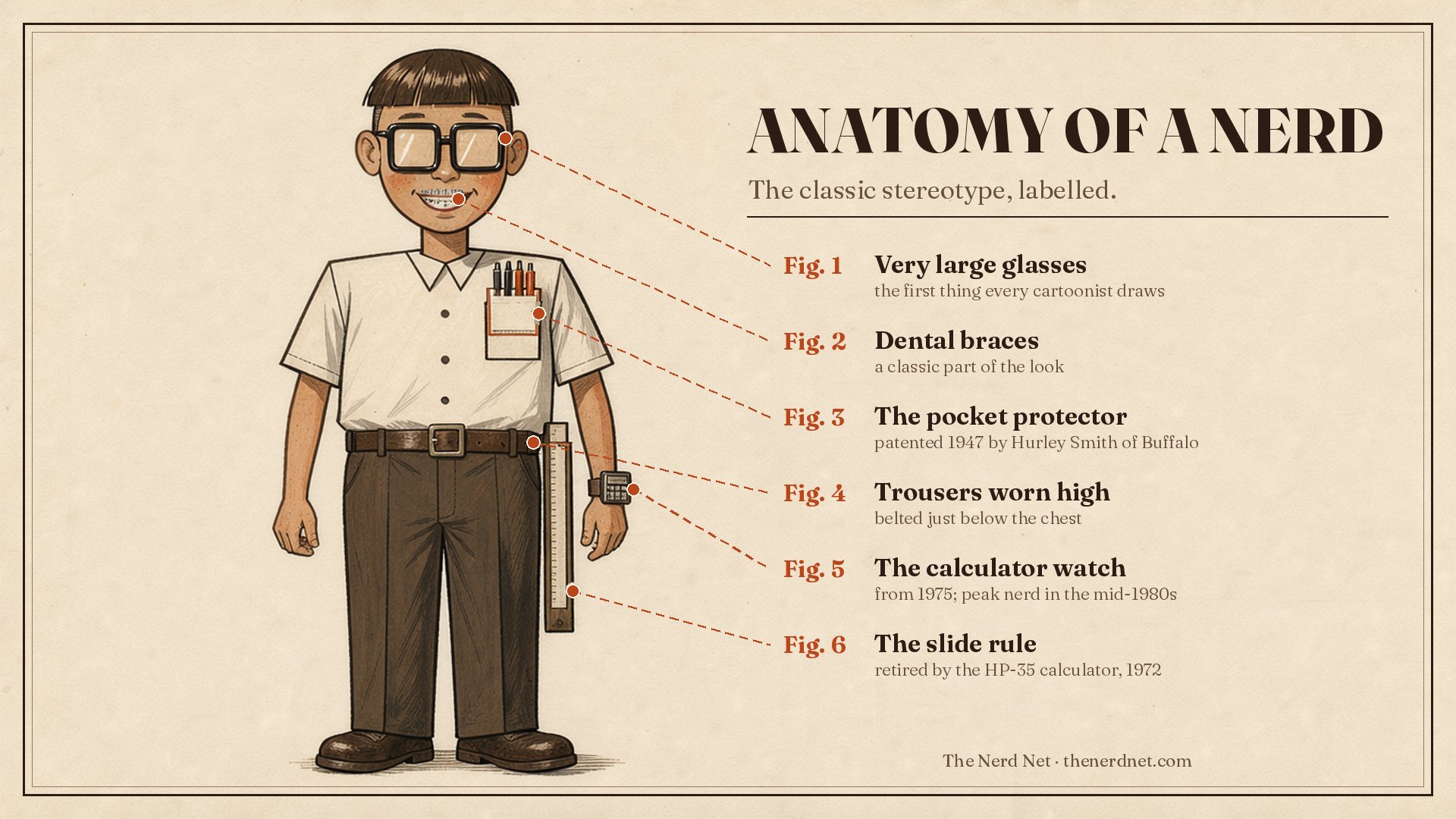
Illustration: The Nerd Net, 2026 (figure drawn with the FLUX AI image model, labelled by us)
The nerd of movies and cartoons comes with a uniform. Put these pieces together and anyone becomes one on sight. Here is the standard issue, figure by figure, with where each part actually came from.
Fig. 1: very large glasses. Every description of the classic nerd starts here. They top the list of the stereotype's features, ahead of everything else below.
Fig. 2: dental braces. Braces are part of the same classic list, along with a weak chin and bad acne. The movies were not kind.
Fig. 3: the pocket protector. This one has a real inventor. During World War II, Hurley Smith, working in Buffalo, New York, came up with a sheath that holds pens and pencils in a shirt's breast pocket and stops them tearing or staining it. He filed for a patent on June 3, 1943, and received US patent 2,417,786 on March 18, 1947. (A rival story credits Gerson Strassberg, a Long Island plastics maker, who is said to have noticed the idea around 1952 when he slipped a plastic sleeve into his pocket during a phone call.) Engineers and students used them, and film costume departments turned them into nerd shorthand.
Fig. 4: trousers worn high. "Pants worn high at the waist" are another fixture of the stereotype. There's no inventor to credit here, just a lot of belts.
Fig. 5: the calculator watch. The first ones appeared in the mid-1970s, from Pulsar (in 1975, then a brand of the Hamilton Watch Company) and Hewlett-Packard. Casio made them famous. Its models turned up in movies and on celebrities' wrists, and in the mid-1980s its Databank watches could store appointments, names and phone numbers as well as do sums. Production peaked in the middle of that decade; today they're sold as vintage fashion.
Fig. 6: the slide rule. For generations, this ruler with a sliding middle strip was how engineers and scientists did multiplication, division and trigonometry. Then, in 1972, Hewlett-Packard launched the HP-35, the world's first scientific pocket calculator, for $395. It sold 100,000 in its first year, and it and the Texas Instruments calculators that followed signaled the end of the slide rule among science and engineering students.
Put it all together and you get a costume, not a person. The real nerds we write about came in every shape. What they share is curiosity, not a pocket protector (though a few of them surely owned one).
Sources
- Nerd — Wikipedia
- Pocket protector — Wikipedia
- Calculator watch — Wikipedia
- HP-35 — Wikipedia